
I’m an Italian travel and documentary photojournalist, and my approach to photography has been unusual, as I also have a strong interest in history.
I dreamed of witnessing contemporary history firsthand, so I left the university to become a photojournalist, with no other options accepted, and I learned how to tell stories with photographs by spending more money than I could afford on books of great photographers, like Eugene Smith, Josep Koudelka, Alex Webb, and David Alan Harvey.
Photography became an integral part of my life, a means of expressing myself, and I shot hundreds of assignments on global politics and documentaries for Italian and international magazines.
It was an invaluable experience to learn to think and react quickly, even in chaotic situations.
However, after many years of editorial reportage, it was time to seek out different stories, as I’m most passionate about in-depth stories rather than breaking news.
I have always loved traveling outside my comfort zone, so I specialized in cultural and documentary issues, publishing travel stories in over fifty countries for leading Italian and European cultural and travel magazines, for which I have completed hundreds of assignments.
To offer a professional package in the increasingly competitive editorial market, I also write the texts for my reportages.
I’m best known for my long-term work about Latin America and Mexico, a place of soul that I love like a second homeland, where I felt the urgency, at times almost anguish, to document, avoiding easy exoticisms, the indigenous communities, a world that was about to disappear forever, overwhelmed by emigration and globalization.
To succeed, it was essential to invest time and emotion, and to draw inspiration from the books of journalists and travel writers such as Kapuscinski, Theroux, or Dalrymple, dismantling the simplifying visions of mainstream news.
Other long-term projects include Believers, which explores faith and syncretisms, and Gaelic Soul, about the Celtic world.
I have published numerous books, collaborated on various projects with NGOs, Mexico City Caritas, Italy’s CNEL, and my photographs are featured at the Photo Library of the United Nations High Commissioner for Refugees (UNHCR).
I received numerous awards, including five prestigious Pluma and Camera de Plata for the best foreign cultural reportage on Mexico. However, my most satisfying experience was meeting and learning from people of such diverse backgrounds.
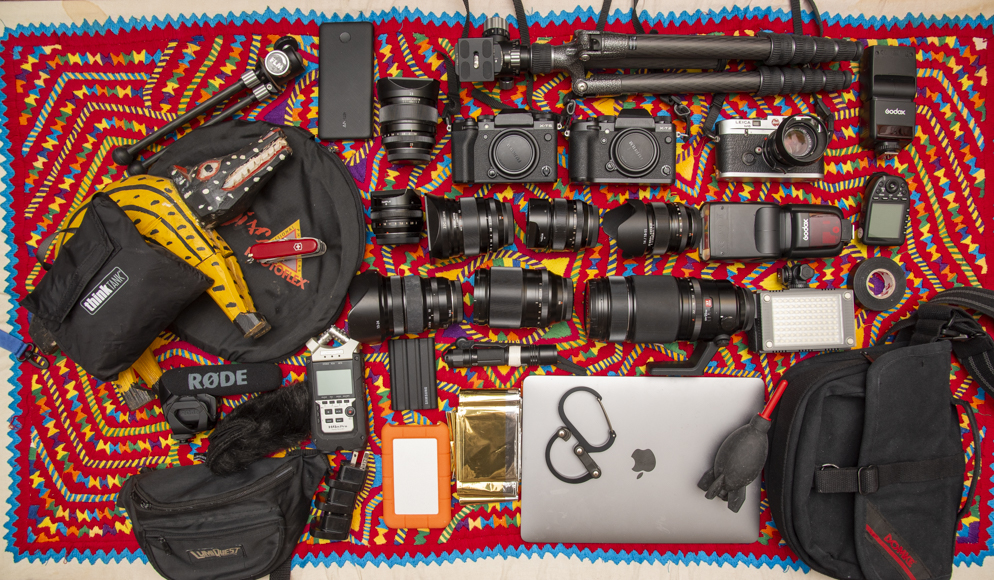
I travel and work alone, and I have used Nikon cameras throughout my career. What I need is a camera that never leaves me in trouble and performs as I want, often in precarious circumstances and isolated places.
Even though I still have a Nikon DSLR system, my gear has evolved due to increasingly tight assignment times and restrictions imposed by many airlines. A lighter camera makes things much easier. Therefore, I use a Fujifilm X-T5, with two Fujifilm X-T2S as backups.
I know, the common wisdom is that an APC camera may not have the dynamic range or low-light capability of a larger-sensor camera, but that only applies in certain situations.
In real life, I have been more than happy to have shot with this quality if it had been available back in the day for my professional assignments, and I’m speaking of high-end target magazines and books.
Not to speak of the last generation software, or the wizardry of the professional printer who creates the prints for my exhibitions.
Since I’m not much involved in video, my primary video camera is an iPhone. If I’m in an analog mood, a Leica M6 with a Summicron 50mm f/2 is probably something I’ll never have the courage to part with.
On assignment, I usually pack only one camera and three or four lenses, with two cameras and other lenses as backup in my hotel. I’m a fast prime lens addict, so the Fujifilm XF16mm, XF23mm, XF35mm, all f/1.4, and XF90mm f/2 are always in my bag.
I don’t use telephoto lenses often, but the Fujifilm XF50-140mm f/2.8 is indispensable for some assignments, such as the XF10-24mm F4 R OIS or XF14mm f/2.8 R.
If I need something smaller and lighter for reportage, I love the compact XF 18mm f/2, too often mistreated.
I’m an available-light guy from the analog era. Still, when I need to create my own light, I love the Godox trigger system that works with my Nikon and Fuji flashes: Nikon SB-800 (x2), Godox TT685F, and Godox TT350F, along with the Lumi Quest Lighting Kit and Lastolite reflectors.
The SmallRig RM 120 and Kaiser StarCluster are my compact, continuous LED lights.
I’m afraid the never-ending search for the Holy Grail of camera bags is still in progress.
Traveling to the destination: for me, it’s Think Tank BackStory 15 or Airport Acceleration.
In the field, I still like the photojournalist-style shoulder bags, mainly the legendary Domke F-2. You either love or hate it for its no-frills approach, and I have literally destroyed at least three of them, but its functional design enables quick gear access.
In the past, I also used the larger Domke F-7, but today I often use the Domke F-803, the smaller F-10, or the Domke sling bag. I also have the Billingham 335 and 550, stylish but heavy and expensive, even if you buy them once and keep them for life.
My Gitzo Basalt tripod traveled with me so much that I don’t remember the exact model. However, today I use the smaller and lighter carbon-fiber Gitzo GK 1555T, which is exceptionally robust for its size, paired with a FLM CB-32 F II ballhead.
If I need something pocketable, the FLM tabletop is the best option, or the Joby Gorillapod 5K for unlikely situations.
I use an IMAC Retina 5K 27, a MacBook Air M1 13, and an Anker Powerbank in the field.
I utilize Capture One to develop Fuji RAF files, Adobe Lightroom Classic to archive and process (mainly dodge and burn), and, for problematic images, Topaz DeNoise, Topaz Sharpen, DxO Pure Raw, and Adobe Photoshop.
In the field, I tend to use the La Cie 4TB Rugged External Hard Drive and the Samsung 2TB T7 Shield.
At home, always two copies of raw and two of TIFF on hard disks stored in different locations, and a cloud storage with Photoshelter.
My audio setup includes a Rode VideoMic Pro Plus shotgun microphone and a Zoom H4n Pro Handy Recorder, ideal for capturing interviews and ambient audio.
My old and beloved ranger hat is a life’s travel companion, and the powerful Fenix Torch PD35 is also helpful for light painting, a Swiss Army knife, and electrical tape. I never travel without them.
When traveling in precarious boats or under heavy rain, the See Bag is the ultimate solution for protecting camera gear.
I prefer to travel light, so I carry at most repellent, some medicine, a water bottle, and chocolate bars. I always prefer local street food, which is also an excellent opportunity to meet someone.
On the other hand, the only time Montezuma’s revenge struck me was at a lunch of a president of a country whose name I will not mention!
The images are inside us, perhaps from childhood, at the end of the world, or on your doorstep.
We rediscover them, looking for fragments of endless possibilities that we see, because reportage requires the humility of those who enter different worlds without the arrogant pretense of judging, but with the ability to be amazed every time in the face of the unexpected.
Credit : Source Post