
Introduction
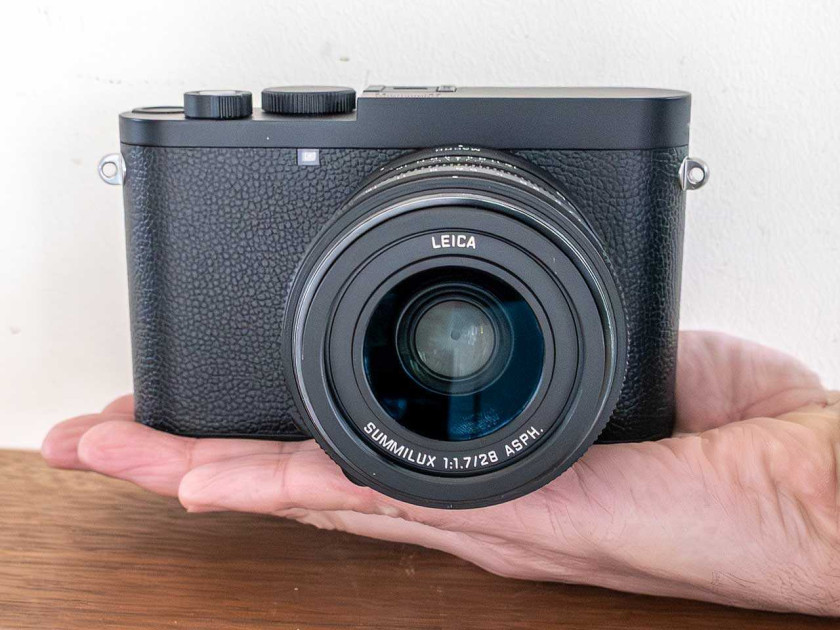
The Leica Q3 Monochrom is a premium fixed lens compact camera which pairs a 60 megapixel 35mm full-frame CMOS sensor with an image-stabilized Leica Summilux 28mm f/1.7 prime lens.
Optically the lens is comprised of 11 lenses in 9 groups (including 3 aspherical lens elements) and it has a Macro setting that enables it to focus as close as 17cms / 6.7″.
This camera uses a 61 megapixel monochrome BSI (BackSide Illuminated) CMOS sensor with no color filter that’s similar to the one found in the M11 Monochrom model.
Key features of the Q3 Monochrom include a sensitivity range of ISO 100-200,000, the latest-generation Maestro IV image processor, 8K/30p, 4K/60p and 1080/120p video recording, a hybrid AF system with an intelligent subject recognition system, and continuous shooting up to 15fps.
This new model for 2025 also offers 350 shot battery life, USB-C connectivity, a 5.76m-dot OLED EVF and a tilting 1.84m-dot touchscreen LCD screen.
The recommended retail price of the Leica Q3 Monochrom is £5800 / $7790 / €6750 in the UK, USA and Europe respectively and it is available in black. It is designed and made in Germany.
Ease of Use
 |
Side by side with the Q3 and Q3 43 models, the Q3 Monochrom has a much more stealthy appearance, with an all-black leatherette coating on the front of its body and the perhaps surprising complete omission of the usual red Leica logo in the front top-right corner.
In addition the Leica Q3 and Monochrom engravings on the top-plate are also completely black, rather than white or grey as on the Q3 / Q3 43, and some of the lens markings have been changed from yellow to grey. Otherwise the three Q3 models are completely identical in terms of their external design, operation and control layout.
The Leica Q3 Monochrom has the same 60 megapixel full-frame BSI (BackSide-Illuminated) CMOS sensor that was initially developed especially for the flagship M11 Monochrom rangefinder camera, which offers a 21% increase on the resolution offered by 2020’s 47.3 megapixel Q2 Monochrom model.
In conjunction with the Maestro IV image processor, this allows the Q3 Monochrom to output 14-bit raw files with a claimed dynamic range of up to 14 stops, provide an extensive ISO range of 100-200,000, and shoot 60 megapixel images at 4fps with continuous AF/AE.
Whilst 60 megapixels will undoubtedly be a big draw for potential owners of this camera, Leica have also sensibly provided two smaller 36 and 18 megapixel modes which help avoid some of the processing and storage challenges of the the 60 megapixel mode while also boosting the burst shooting buffer times.
 |
So the Q3M can be set to record 60, 36 or 18 megapixels DNG Raw images with 14-stop dynamic range using the full sensor area, something that Leica are calling “Triple Resolution Technology”.
The Leica Q3 Monochrom has a fixed, as opposed to removable, lens. The 28mm focal length provided is all-encompassing and makes this camera particularly suitable for landscape and travelogue photography.
A straightforward and clearly marked macro setting on the lens barrel allows subjects as close as 17cm to be captured, while otherwise the minimum focusing distance is a regular 30cm. The manually selectable aperture range extends from f/1.7 up to f/16 with an automatic setting provided too.
This is coupled with a bright/fast f/1.7 aperture to allow for lower light shooting hand-held. As the lens is fairly wide the user is naturally prompted to get quite close to their subjects if they want them to fill the frame, or the majority of it, to really make the most of the ‘bokeh’ opportunities offered by that maximum aperture.
Leica has additionally provided a screw-on/screw off lens hood, should you wish to use it as an additional aid to preventing lens flare, or avoid unwanted artifacts in brighter conditions. There’s also a thread on the front for traditional 49mm glass filters.
 |
Impressively the lens is optically stabilized, a surprising feature given the wide-angle, full-frame nature of the lens, which coupled with the impressive noise performance at high ISOs makes it very easy to hand-hold the Q3 Monochro in less than perfect lighting conditions and still achieve pin-sharp results.
In addition to the 28mm optical focal length, the Q3 provides four different crop modes that simulate longer focal lengths.
At the press of the small unmarked button next to the rear thumbgrip on the rear of the camera, you can switch to 35mm, 50mm, 75mm and a brand new 90mm crop mode, with a rectangular overlay displayed to help with composition.
The 35mm equivalent crop provides 39 megapixels resolution, the 50mm crop 19 megapixels, the 75mm crop 8 megapixels and the 95mm crop 6 megapixels.
These digital crops are only applied to the JPEG files, with a full-size 60 megapixel DNG Raw file also recorded at the same time.
 |
As the camera is cropping into the full-size image, rather than interpolating up a la most digital zooms, there’s no degradation of the image quality, just a reduction in the megapixel count.
You could of course apply similar crops yourself during post-processing, but providing them in-camera has the main added benefit of making composition much easier and more intuitive whilst also saving on memory card space.
The 35mm and 50mm crop modes proved to be genuinely useful, effectively giving you a 28-50mm focal range that’s easy to use whilst still offering enough resolution.
The 75mm and 90mm modes are harder to use due to the tiny are of the frame that’s made available for composition – the camera really needs to provide higher magnification when using these modes – and also the sub-10 megapixel resolution images that are recorded.
There is no built-in flash provided on the Leica Q3 Monochrom, although there is a provided hotshoe for the addition of flash, should that be required.
 |
As you’d probably expect of a Leica camera, manual focusing on the Q3 Monochrom is a veritable joy, although the means of switching between AF and MF is quite subtle and initially well hidden.
Switching to manual focus occurs via a fingernail press of the so tiny you’ll miss it lever on the lens itself, that in turn allows the lens ring to move (it’s ‘stuck’ in place in auto mode) and manual distance markings on said barrel to be selected, whereby the camera provides the user with an enlarged portion of the subject on-screen, allowing focus to be more critically determined.
Auto-focusing on this new Q-series camera incorporates a contrast-based AF system that does not include phase detection as well as contrast detection pixels, as on the colour versions.
In practice, auto-focusing wasn’t noticeably that much slower than on the PDAF-equipped Q3 and Q3 43. Interestingly, it additionally employs Panasonic’s depth from defocus system to build up a depth map of the scene to further enhance the AF.
The Q3 Monochrom also benefits greatly from the addition of intelligent subject recognition. It’s a pretty simple system by modern standards that only recognises the eyes, faces and bodies of people plus animals, with two rather confusing options buried at the bottom of the AF Mode menu – the first option is Eye/face/Body Detection and the second is Eye/Face/Body + Animal Detection (why isn’t animal detection separate?) – but at least it works well enough in practice.
 |
Leica camera have never been particularly renowned for their blistering continuous shooting rates, and the Q3 Monochrom is certainly no exception to that rule.
While on paper it offers up to 15fps bursts, the reality is that the focus and exposure are locked at the first frame until you drop down to a rather more pedestrian 4fps. The buffer is at least 63 shots in RAW, though, so you can at least shoot for a long time at 4fps before that rate slows down.
Some photographers may also argue that 4fps is more than fast enough for a street camera with a standard focal length lens, especially as the excellent autofocus system can be employed at the same time.
The Q3 Monochrom has both a mechanical shutter that provides speeds between 120sec to 1/2000sec and an electronic shutter that runs from 1sec to 1/16000sec, with a Hybrid option also available that automatically switches between them. Flash synchronization is up to 1/200sec.
This isn’t just a camera for stills, as Leica have included DCI 8K video recording. DCI 8K which is supported at up to 30p with 4:2:0 10-bit color when recording internally or at 8-bit when recording externally via the micro-HDMI port.
 |
If you only need 4K recording, that’s provided at up to 60p with 4:2:2 10-bit color internally or externally, while Full HD runs up to 120p for slow motion playback.
Other key video features include ProRes recording at 1080/60p, Leica’s L-log profile, and LUT compatibility. The Q3 Monochrom doesn’t have a microphone socket, though, instead relying on its USB-C port to allow an audio input.
This port can also be used to charge the camera via a powerbank, useful for extending the battery life when out and about. Talking of which, the Q3 Monochrom uses a battery, the BP-SCL6, which has a CIPA-rated lifespan of 350 shots per charge. The Q3 Monochrom is also still compatible with the BP-SCL4 battery that was used in the Q2M.
The electronic viewfinder that sits in the corner of the camera has also received a significant upgrade, with the resolution being bumped up from 3.68 megapixels on the Q2M to 5.76 on the Q3 Monochrom. It has a 0.79x magnification and either a battery-conserving 60fps or a smooth 120fps refresh rate for more realistic motion rendering.
The tilting 3-inch, 1.84M dot LCD touchscreen can be moved both upwards and downwards to suit working from a variety of shooting positions, rather than fixed in place as on the previous Q models, which makes waist-level and overhead shooting much easier.
 |
The screen does rather spoil the aesthetics of the Q3 Monochrom, however, as it juts out slightly from the rear of the camera, interrupting the smooth lines. Still, this is first and foremost a photographic tool, rather than an expensive ornament, so we can overlook this slight faux pas on Leica’s part.
It has also necessitated a restructuring of the controls on the rear of the camera compared to the Q2M. Instead of the vertical row of three buttons to the left of the LCD screen, the Play and Menu buttons have been moved to above and below the D-pad respectively, with the customisable Function button moving alongside the Photo/Video button. The shutter button is threaded to accept a mechanical cable release.
The Q3 Monochrom supports the HG-DC1 Wireless Charging Handgrip, an optional accessory that when fitted facilitates wireless battery charging via Qi-compatible charging mats, such as the Drop XL Wireless Charger that Native Union has made especially for Leica.
For the first time ever in the Q camera series, the Q3M supports Content Credentials, a technology by the Content Authenticity Initiative (CAI) which adds a digital signature to images to help verify their origins and any post-processing which made its debut in the SL3-S model.
Image Quality
All of the sample images in this review were taken using the 60 megapixel Large setting, which produces an average image size of around 35Mb for JPEGs and 90Mb for RAW files.
The Leica Q3 Monochrom recorded still images of outstanding quality during the review period.
This camera produces noise-free JPEG images at ISO 100 up to ISO 6400, with some noise starting to appear at ISO 12500. The faster settings of ISO 2500 through to 100000 are still very usable, although we’d suggest avoiding the fastest ISO 200000 setting if at all possible. The corresponding Raw files have much less obvious artifacts but are noticeably less sharp than their JPEG equivalents.
Noise
ISO sensitivity can be set between ISO 100 and ISO 200,000 in full-stop increments. Here are some 100% crops which show the noise levels for each ISO setting, with JPEG on the left and RAW on the right.
Focal Range
The Leica Q3 Monochrom’s lens provides a focal length of 28mm in 35mm terms, as demonstrated below.

Crop Modes
The Leica Q3 Monochrom offers digital crop modes simulating 35mm, 50mm, 75mm, and 90mm focal lengths in addition to the true 28mm focal length that the lens supplies, complete with frame lines in the viewfinder for composition.
 28mm
28mm
 35mm
35mm
 50mm
50mm
 75mm
75mm
 90mm
90mm
Macro
The Leica Q3 Monochrom offers a Macro setting on the lens barrel that allows you to focus on a subject that is 17cms / 6.69″ away from the camera.

Intelligent Dynamic Range (iDR)
The Intelligent Dynamic Range function allows an optimization of the darker areas in a JPEG image, with object details become much clearer. There are three different available strengths, Low, Standard and High, plus Auto and Off settings.
 Off
Off
 Low
Low
 Standard
 High
High
 Auto
Auto
Leica Looks
Leica’s Looks are preset combinations of different contrast, highlight, shadow and sharpness settings for JPEGs only. The Leica Q3 Monochrom’s four default Looks are shown below in the following series, which demonstrates the differences between them.
You can tweak the preset styles so that you can create your own particular look, although you can’t create brand new ones in-camera. Instead you can download up to seven additional Leica looks to the camera via the Leica Fotos app.
 Monochrom
 Sepia
Sepia
 Selenium
 Blue
Blue
Sample Images
This is a selection of sample images from the Leica Q3 Monochrom camera, which were all taken using the 60 megapixel Large JPEG setting. The thumbnails below link to the full-sized versions, which have not been altered in any way.
Sample RAW Images
The Leica Q3 Monochrom enables users to capture RAW and JPEG format files. We’ve provided some Leica RAW (DNG) samples for you to download (thumbnail images shown below are not 100% representative).
Sample Movies & Video
Product Images


Conclusion
All of the things that were true of Leica’s previous black and white cameras still apply to the new Q3 Monochrom. Clearly an all-mono camera with a fixed 28mm lens that costs £6000 / $8000 is something of a niche proposition, but if you do fall into that niche, you’ll be absolutely delighted with the improvements that have been made since 2020’s Q2M.
As with the regular Q3, chief amongst these is not the 60 megapixel resolution or 8K video, which will surely garner most of the headlines, rather the incorporation of the tilting LCD screen and higher-res EVF that add an awful lot to the cameras handling and versatility.
The improved auto-focus system complete with subject-detection combined with the flawless manual focusing also makes the Q3M a veritable joy to use, although the AF system does lack the phase-detection method of the colour models (thankfully not to any great detriment in practice).
Out of all the monochrome cameras that Leica have produced, the Q3M is simply the easiest to use, the most versatile and produces the best image quality.
You may have the obvious advantage of being able to change the lens on the M11 Monochrom, but there’s a lot to be said about the pairing of the optically stabilized, auto-focusing 28mm lens and the 60 megapixel sensor on the Leica Q3M, aided by the extra versatility of the 35mm, 50mm, 75mm and 90mm crop modes and the simply incredible low-light performance at high ISOs.
This is backed up by the strictly B&W composition method. Whereas on the M-series monochrome rangefinders you still see the world in colour whilst composing your image, the Q3 Monochrom’s black and white EVF forces you to think in this way from the get-go. This is definitely a positive thing in our book, as it really does change how you see the world and subsequently what kind of photographs you take.
The majority of people will look at the price-tag, roll their eyes and instantly mutter something about being able to convert colour to black and white, but they’re certainly not the target audience for this very special camera.

| Ratings (out of 5) | |
|---|---|
| Design | 4.5 |
| Features | 4.5 |
| Ease-of-use | 4.5 |
| Image quality | 5 |
| Value for money | 4 |
Main Rivals
Listed below are some of the rivals of the Leica Q3 Monochrom.
The Leica M10 Monochrom is a manual focus rangefinder camera that only shoots in black and white and costs a whopping £7250 / $8295 for the body only. Does this super-niche version of the M10 offer the best ever b&w image quality? Find out now by reading our in-depth Leica M10 Monochrom review, complete with full-size JPEG and Raw sample images.
The Leica M11 is a brand new digital rangefinder camera for 2022, offering a 60 megapixel full-frame BSI CMOS sensor, 64Gb built-in memory, longer battery life and USB-C charging. Oh, and did we mention that Leica have dropped the removable baseplate, a feature that has adorned M-series cameras for literally decades? Find out if this is the best ever fusion of old and new tech by reading our in-depth Leica M11 review, complete with full-size sample photos.
The Leica Q2 Monochrom is a 35mm full-frame compact camera with a 28mm fixed focal length lens that exclusively only shoots in black and white. With a price tag of £5000 / $6000, is this a niche product that no one will buy, or somebody’s idea of a dream camera? Find out now by reading our in-depth Leica Q2 Monochrom review, complete with full-size sample photos and videos…
The Leica Q2 is an exciting full-frame mirrorless compact camera with a 28mm fixed lens. The Q2 features a a new 47.3 megapixel sensor, 4K video mode recording at 30/24fps, high-resolution OLED viewfinder, dust and water resistance, and focusing speed of 0.15 seconds. Is this the ultimate compact camera? Find out now by reading our in-depth Leica Q2 review, complete with full-size sample photos and videos…
The Leica Q3 43 is a compact camera like no other, with a 60 megapixel full-frame sensor, 8K video recording and a brand new 43mm f/2 fixed lens, all housed in a traditional, pared-back body. Find out more by reading our in-depth Leica Q3 43 review, complete with full-size sample photos and videos…
The Leica Q3 is a compact camera like no other, with a 60 megapixel full-frame sensor, 8K/30p video recording, hybrid AF system and a 28mm f/1.7 fixed lens all housed in a traditional body. Is this the ultimate tool for street and landscape photography? Find out now by reading our in-depth Leica Q3 review, complete with full-size sample photos and videos…
After almost three years since it was first unveiled, the Zeiss ZX1 full-frame mirrorless camera is finally available to buy. With a 37.4 megapixel sensor, 4K video, 35mm f/2 prime lens, 4.3-inch touchscreen, built-in Adobe Lightroom and 512Gb SSD internal memory, is the unconventional ZX1 still worth a look in 2021? Find out now by reading our in-depth review of the Zeiss ZX1 mirrorless camera, complete with full-size sample photos, test shots, videos and more…
Review Roundup
Reviews of the Leica Q3 Monochrom from around the web.
Of course, it isn’t for everyone, in common with all Monochrom cameras. But if you want black and white only, then the Q3 Mono is a really classy option. The possibility to crop digitally and still get a great file (even down to 90mm) makes it an incredibly versatile solution to almost any photographic situation. More than that, the image files are just a pleasure to process.
Read the full review »
The Leica Q3 Monochrom assumes three things: that you want a fixed-lens camera, that you only shoot black-and-white, and that cost isn’t a factor. If you do not agree with all three, stop reading now because this camera isn’t for you. Still here? Then you’re in for a treat. The sensor produces remarkably clean and undeniably beautiful black-and-whites, with the 60.3MP resolution delivering enviable image quality along with a digitally adaptable focal length. With its glorious Summilux lens and sublime mono rendering, the Leica Q3 Monochrom is certainly the purest, and arguably the finest, street photography camera you’ll ever use.
Read the full review »
The Leica Q3 Monochrom renders the world in deep, expressive black and white, offering tonality and dynamic range that color cameras simply can’t match. It’s a dream for photographers who prefer to skip color—so long as they can justify the price.
Read the full review »
Specifications
| Designation | Leica Q3 Monochrom |
| Camera type | Digital 35 mm compact camera |
| Type No. | 6506 |
| Order No. | 19 200 EU/US/CN, 19 201 JP, 19 202 ROW |
| Buffer memory | 8 GB |
| Storage medium | UHS-II (recommended), UHS-I, SD/SDHC/SDXC memory card |
| Material | Full metal housing: magnesium die-cast, leather covering, protection type IP52 |
| Operating conditions | 0°C to +40°C |
| Interfaces | ISO accessory shoe with additional control contacts for Leica flash units, HDMI jack Type D, USB 3.1 Gen 2 Type C up to 10 Gbps |
| Tripod thread | A 1⁄4 DIN 4503 (1⁄4”) with stainless steel in the base |
| Dimensions | 130 x 80,3 x 92,6 mm |
| Weight | Approx. 746 g/662 g (with/without battery) |
| Sensor | |
| Sensor size | CMOS sensor, 62.39 MP/60.3 MP (total/effective) |
| Processor | Leica Maestro series (Maestro IV) |
| Filter | no low-pass filter |
| File formats |
Photo: DNG™ (raw data), DNG + JPG, JPG (DCF 2.0, Exif 3.0) MOV |
| Image resolution | DNG™ 9520 x 6336 Pixel (60,3 MP) 7404 x 4928 Pixel (36,5 MP) 5288 x 3518 Pixel (18,6 MP) JPG 9520 x 6336 Pixel (60,3 MP) 7392 x 4928 Pixel (36,4 MP) 5280 x 3512 Pixel (18,5 MP |
| File size | DNG™: approx. 70 MB, depending on resolution and image content JPG: depending on resolution and image content Video: max. length: 29 min |
| Bit depth | DNG™: 14 bit/12 bit JPG: 8 bit |
| Video Resolution | C8K (17:9) 8192 x 4320 8K (16:9) 7680 x 4320 C4K (17:9) 4096 x 2160 4K (16:9) 3840 x 2160 Full HD (16:9) 1920 x 1080 |
| Video frame rate/bit rate |
MOV C8K (recording to SD) MOV C8K (HDMI output with HLG/L-Log or during recording to SD) MOV 8K (recording to SD) MOV 8K (HDMI output without HLG/L-Log and without recording to SD) MOV 8K (HDMI output with HLG/L-Log or during recording to SD) MOV C4K MOV 4K MOV FHD MOV FHD Slow Motion MOV FHD ProRes MP4 8K MP4 4K MP4 FHD |
| Lens | |
| Designation | Leica Summilux 28 f/1.7 ASPH., 11 lenses in 9 segments, 3 aspherical lenses |
| Lens filter thread | E49 |
| Digital zoom | Optionally approx. 1.25x (equivalent to 35 mm), approx. 1.7x (equivalent to 50 mm), approx. 2.7x (equivalent to 75 mm), or approx. 3.2x (equivalent to 90 mm) |
| Image stabilization | Visual compensation system for photos and video recordings |
| Aperture range | F1.7 to F16 in 1⁄3 EV increments |
| Viewfinder/Display | |
| Viewfinder (EVF) | Resolution: 5,760,000 dots, 120 fps, magnification: 0.79x at aspect ratio: 4:3 / 0.76x at aspect ratio: 3:2, frame coverage: 100%, exit pupil position: 20.75 mm, setting range -4/+2 dpt, with eye sensor for automatic switchover between viewfinder and LCD panel, time delay 0.005 s |
| Display | 3” TFT LCD, approx. 1,843,200 dots, 384 ppi, aspect ratio 3:2, touch panel |
| Shutter | |
| Shutter type | Mechanical central shutter or optional electronic shutter |
| Shutter speeds | Mech. shutter: 60 min to 1⁄2000 s Electro. shutter function: 60 s to 1⁄16000 s Flash Synchronization: up to 1⁄2000 s |
| Shutter button | Two-stage (1st stage: Activation of the camera electronics including autofocus and exposure metering, 2nd stage: Taking the picture) |
| Self-timer | Delay time: 2 s or 12 s |
| Drive Mode |
Single, Continuous Shooting, Interval Shooting, Exposure Bracketing, Multi-Shot Continuous shooting: 7 B/s, 14 Bit, AF – 9 B/s, 12 Bit, AF – 15 B/s, 12 Bit, AF |
| Focusing | |
| Focus range | 30 cm to ∞ With macro setting: from 17 cm |
| Focus mode | Automatic or manual With manual setting: optional magnifying glass function (Auto Magnification) and edge marking (Focus Peaking) available as focus assist |
| Autofocus system | Contrast detection |
| Autofocus modes | Intelligent AF (automatically refocuses as soon as something changes in the scene), AFs, AFc, AF setting can be saved, optional Touch AF |
| Autofocus metering methods | Spot (can be shifted), Field (can be shifted and scaled), Multi-field, Zone (can be shifted and scaled), Eye/Face/Body Detection, Animal Detection (Beta), Tracking |
| Autofocus metering fields | 315 |
| Exposure | |
| Exposure metering | TTL (exposure metering through the lens), with working aperture |
| Metering principle | Exposure metering is done by the image sensor for all exposure metering methods (in Live View mode and in rangefinder mode) |
| Exposure metering methods | Spot, Center-Weighted, Highlight-Weighted, Multi-Field |
| Exposure modes | Program AE mode (P) Aperture-priority mode (A): manual aperture setting Shutter-priority mode (S): manual shutter-speed setting Manual (M): manual setting for shutter speed and aperture Various fully automatic variants (Scene Mode): AUTO, Digiscoping |
| Exposure compensation | ±3 EV in 1⁄3 EV increments |
| Automatic bracketing | 3 or 5 frames, graduations between shoots up to 3 EV, in 1⁄3 EV increments additional optional exposure compensation: up to ±3 EV |
| ISO sensitivity range | Foto: Auto ISO 200–ISO 200 000 Manual: ISO 100–ISO 200 000 Video: Auto ISO 100–ISO 200 000 Manual ISO 100–ISO 200 000 |
| Dual Basis ISO settings | Foto: Low Basis-ISO ISO 100–ISO 560 High Basis-ISO ISO 640–ISO 200 000 Video: Low Basis-ISO ISO 100–ISO 560 High Basis-ISO ISO 640–ISO 200 000 |
| Flash | |
| Flash unit connector | Via the accessory shoe |
| Flash sync time | 1⁄2000 s, slower shutter speeds available. High-speed shutter times between 1/2500 s and 1/16000 s are available only via the electronic shutter. Shorter shutter speeds, however, are only available via the mechanical shutter. |
| Flash exposure metering | Using center-weighted TTL pre-flash metering with Leica flash units (SF 26, SF 40, SF 58, SF 60, SF 64) or with system-compatible flash units, remote controlled flash SF C1 |
| Flash exposure compensation | SF 40: ±2 EV in 1⁄2 EV increments SF 60: ±2 EV in 1⁄3 EV increments |
| Equipment | |
| Microphone | Stereo |
| USB Audio | Compatible RØDE USB audio devices include: VideoMic GO II, VideoMic NTG, Wireless GO II, Wireless ME, and other supported USB microphones. |
| Speaker | Mono |
| WLAN | WLAN function for connecting to the Leica FOTOS app. The Leica app is available from the Apple App Store™ or the Google Play Store™ Maximum output (e.i.r.p.): <14 dBm, encryption method: WLAN-compatible WPA™/WPA2™/WPA3™ |
| Bluetooth | Bluetooth 5.0 LE: Channel 0–39 (2402–2480 MHz), maximum output (e.i.r.p.): 10 dBm |
| GPS | Not available everywhere due to country-specific legislation; can be added via the Leica FOTOS app. Data is written to Exif header of the picture files. |
| Menu languages | English, German, French, Italian, Spanish, Portuguese, Russian, Japanese, Traditional Chinese, Simplified Chinese, Korean |
| Power supply | |
| Rechargeable battery (Leica BP-SCL6) |
Lithium-ion rechargeable battery, rated voltage: 7.2 V (DC); capacity: 2200 mAh (min.), 302 shots (based on CIPA standard), 1535 shots (based on CIPA standard with adapted shooting cycle*) Manufacturer: Panasonic Energy (Wuxi) Co. Ltd., Made in China *Cycle 1: Switch on, 1st shutter release after 5 s, one shot every 3 s, the camera switches off after 10 shots (Auto Power Off) and switched back on after a waiting time of 5 min. *Cycle 2: Switch on, 1st shutter release after 5 s, one shot every 3 s, the camera switches off after 50 shots (Auto Power Off) and switched back on after a waiting time of 5 min. These cycles are repeated alternately until the battery is empty. |
| USB-C power adapter (Leica ACA-SCL6) (optional) |
Input: AC 100–240 V, 50/60 Hz, 0.25 A, automatic switchover; Output: DC 5 V/9 V, 3 A; Manufacturer: Salom Electric (Xiamen) Co., Ltd., Made in China |
| Charger (Leica BC-SCL4) (optional accessory) |
Input: AC 100–240 V, 50/60 Hz, 0.25 A, automatic switchover; output: DC 8.4 V 0.85 A; manufacturer: Salom Electric (Xiamen) Co., Ltd., Made in China |
| USB-C DC Coupler (Leica DC-SCL6) |
Input: DC 9 V/3 A (min.), Output: DC 9 V (with ACA-SCL6), supports USB PD 3.1, Manufacturer: Salom Electric (Xiamen) Co., Ltd., Made in China. |
| Charging via USB | During operation: 9 V/3 A (min. 27 W) With camera switched off: 5 V/1500 mA (2.5 W or greater) |
| Wireless Charging | Optimal performance with 9 V chargers (10 W Charging Pad required) |
| Rated values for input voltage/power | 7.2 V 2.3 A (battery), 5 V 3.0 A / 9 V 2.5 A (USB) |
Your Comments
Credit : Source Post